Tuesday, July 17, 2012

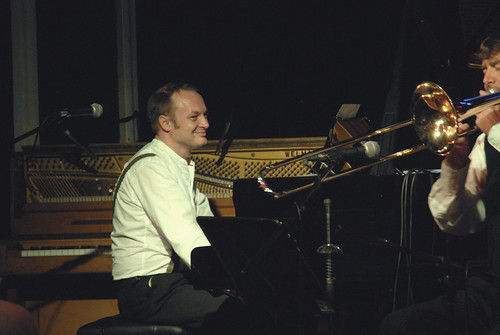
Dakhla, Im & Roller Trio - Manchester Jazz Festival 2012

BBC Introducing with Gilles Peterson and Jez Nelson, Band on the Wall. Monday 16th July 2012. 

This was a little different to other MJF gigs. One, because it's recorded for Radio 3 and two, because the artists were chosen by Jez Nelson, Gilles Peterson and Kevin LeGendre, all from the BBC in some guise. The artists were selected from acts that had applied to the BBC Introducing scheme.

Bristol's 'Dakhla' were a perky two sax, trumpet and drum affair. This band were more about the horn arrangements than improvisation as such, drawing on a wide selection of traditions from balkan music to afro beat and funk. I particularly enjoyed Matt Brown's vibrant open ringing drum sound, giving his fab loose grooves an added low rumble tastiness.  There were hints of Seb Roachford in there, as well as the Polar Bear sound generally, but Dakhla have very much their own thing, and very engaging it is too. 


If 'Dakhla' weren't about the improvisation, 'Im' very much were, largely of the free variety. There was a certain genteel and rustic charm to this outfit, some elements of the sound having stirred up a little nostalgia for the BBC Radiophonic workshop themes. The deep echo reverb Hammond organ sound was also reminiscent of early 70s Pink Floyd, along with the filtered minimoog sounds adding to the retro vibe. Despite the generally unstructured approach, a number of arranged horn parts were layered in by the excellent sax and trumpet players. There was also some lovely woody sounding manipulated trumpet improvising that I eventually worked out was reminding me of Jon Hassell's contributions to David Sylvian's work. 'Im' inevitably are not going to be everyone's cup of tea, but hats off to them for a great little set, and the BBC for giving them this airing.


The last act of the night for me were 'Roller Trio'.  They're one of those acts that cram lots of different styles in a track in what can sometimes sound like a bit of a scissor and paste job to some ears. The tracks tend to be quite long and complex, having lots of sections with dramatically different tempos, dynamics, time signatures, harmony etc. This can be a little frustrating from a listening point of view, especially when you really like a section, but it's what they do, so that's fair enough I guess. The playing's of a high standard, with some really nice grooves emanating from the drums of Luke Reddin-Williams (whose fragmented style and mannerisms were not a million miles from Manchester's own Luke Flowers). Sax player James Mainwaring and guitar player Luke Wynter can both also get round a tricky time signature while laying down some decent sounds. Ultimately though, there was something about it that I couldn't engage with to any great extent.  Reductio ad absurdum summary: Trio VD without the distortion pedals.


Sunday, July 15, 2012

Stevie Williams and The Most Wanted Band. A Greater Horror - Manchester Jazz Festival 2012

Stevie Williams and The Most Wanted Band, Festival Pavilion. Saturday 14th July 2012.

Saturday kicked off with some excellent blues and roots from Stevie Williams and the well honed Most Wanted Band.  Top stuff this was if you like a guitar solo or two, with consistently excellent playing from both Steve Buckley and Markie Creswell on said instrument. An authenticly down home swamp feel was perfected for a cover of Tom Waits 'Chocolate Jesus', Creswell somehow managing to get a lovely deep reverbed banjo sound from his electric guitar, with Buckley laying some suitably moody pedal steel slide over the top. The band have Zelig like skills, tapping into a range of vintage sounds, with 50s rock n'roll and bebop, 60s funk, and 70s laid back California folk rock all delivered with a knowing subtlety of the right sort. I especially loved the tight groove and grind of their excellent take on The Meters' 'Ride a Pony'. A standing ovation was received for a justifiably great set. I'll be checking them out again for sure.


A Greater Horror, Festival Pavilion. Saturday 14th July 2012.

A Greater Horror get a 'challenging jazz' rating of around medium.  There were no hard edges as such, and indeed, Rodrigo Constanzo's always present Fender Rhodes sound frequently fired off comfortable Weather Report and Chick Corea neural paths for me.  Nevertheless, the arrangements were disorientating and rhythmically insistent. Constanzo was often sampling and looping himself, then playing over the top. This generally worked, but too often resulted in a rumbling harmonic density that obscured any movement and direction. The band were at their most effective on the good number of sparse track introductions, managing to convey an effective sense of threatening mysteriousness.  An upper range octavided solo from bass player Mauricio Pauly provided a welcome textural intrusion at one point, somewhat reminiscent of early King Crimson. There was plenty of interest here for sure, but it was a bit of a mixed bag.


Saturday, July 14, 2012

Pocket Central. Alice Zawadzki - Manchester Jazz Festival 2012

Pocket Central. Band on the Wall. Friday 13th July 2012.

It's seven years apparently since Pocket Central's last MJF gig, but they still have the groove aplenty. Tonight's gig at the Band on the Wall mixed classics from the likes of Prince and Chaka Khan with plenty of home spun tunes, this lot giving the festival a bright and fresh kick start. Neil Fairclough on bass nailed the bottom end handsomely, assisted by Bryan Hargreaves on drums.  There was tons of tasty stuff on top too, notably from the guitar of Johnny Hayes and the vibrant sax of Sam Healey. The centre of the pocket was indeed struck.

Alice Zawadzki: Songs from Around the World. Matt and Phreds. Friday 13th July 2012.

Over then to Matt and Phreds for the second set from Alice Zawadzki and her band of merry men and women. Alice and the band did a fine job of putting things across to a bustling and vibed up Friday night crowd, but it was a little tricky on some of the quieter sections. There's no doubt Alice really has something, her voice managing to convey a real passion and intimacy. Much of her song writing was enticing too, usually coming across best in the opening sections of the tunes. One track's fab opening (sorry didn't catch the name) led into an improvisation section of dark chords over an awkward time signature that I felt had the band a little on the edge, but there's promise of great things to come here I'm sure.  Wednesday's duo with pianist Dan Whieldon looks to a must.

Sunday, November 20, 2011

Henry Threadgill Zooid + John Escreet - London Jazz Festival 2011

Queen Elizabeth Hall, South Bank, London. Saturday 19th November 2011.

John Escreet is a New York based pianist originating from the northerly English environs of Doncaster. It's tempting to think these cultural juxtapositions are reflected in his music, as he quietly drew us into his short set, using some carefully chosen sparse bleak long notes, that slowly developed into angst ridden arpeggio flourishes. From here, we knew where this was going, Escreet attacking the keys to deliver rapid fire dense note clusters. Following a sort-of twisted psychotic rag, Escreet finally sweetened the harmony, but even then, expected resolutions were frequently side-stepped. It's difficult material, but Escreet's precision and conviction make it very engaging.

Without the fluid central groove of Elliot Kavee’s brilliant drumming, the relentless harmonic tension generated by Henry Threadgill’s ‘Zooid’ would have overwhelmed most brains used to a least the odd chord resolution here and there. The icy solo cello introductions from Christopher Hoffman were the most effective element, managing to convey strong statements within the constraints of Threadgill’s interval block system. Bass player Stomu Takeishi was engaging to watch, but unfortunately the instrument was too loud in the mix for the most part. The trombone and tuba of Jose Davila, and the guitar of Liberty Ellman played more of a supporting role, at least sound mix wise, but both managed to shine when given enough harmonic space to get their lines through. Threadgill mainly took on the role of overseer, but his distinctive contributions on alto sax and bass flute really added to the dynamic, so it would have been good if he’d taken more of a playing role.

The Zooid experience is exhausting, albeit in many ways worthwhile. I can’t deny that at times, my ear begged for a solid funky bass line to lock in with the gorgeous drumming. I do also wonder that, although Threadgill’s interval block serialism is an interesting original approach, its constraints give rise to the same sort of difficulties Steve Reich had with Schoenberg’s twelve tone serialism, in that it’s difficult to “sneak in some harmony”. I suspect I’ll continue to muse on this one.

Thursday, November 17, 2011

Kenny Wheeler, Norma Winstone and the London Vocal Project - London Jazz Festival 2011

St James’ Piccadilly, London. Wednesday 16th November 2011.

It would be a sour soul who wasn’t just a little moved by the joyous atmosphere inside the St James’ Church, Piccadilly last night for an evening with Kenny Wheeler and the London Vocal Project. To get us in the mood, we were treated to the world premiere of ‘Horizons’, a piece written specially for a young singer, Kwabena Adjepong, by pianist Gwilym Simcock. I don't mind a bit of sentimentality at all, but there was a tad too much for me here (or I wasn't in the mood). The deep richness of Adjepong’s voice does however, promise much for the future.

There was an appropriately reverent reception when the great Kenny Wheeler approached the stage for this rare performance of the ‘Mirrors Suite’, a setting of poems by Stevie Smith, Lewis Carroll and W. B. Yeats for band and choir. It was really magic stuff. To hear classic Wheeler harmonies performed by the great players Nikki Iles on piano, Mark Lockheart on sax, Norma Winstone on vocals, Steve Watts and James Maddren on bass and drums, along with the 20-piece London Vocal Project led by Pete Churchill was an absolute treat.

The suite contains all the best of the Wheeler compositional devices, with rich modal harmonies sweeping their way through waves of sequences over silky swing beats. Wheeler delivered a number of his classic searching solos, firing up into the high registers of the flugal horn in that way only he does. Iles was rhythmically really on it tonight, delivering some really exciting punchy lines. Lockheart sounded the best I’ve heard him, especially when on soprano sax, his tone being quite delicious, and his lines strong and coherent, with every note counting.

I hope this wonderful piece gets recorded at some point, preferably with this same band and choir. It would be a sin if it wasn't.

Wednesday, November 16, 2011

Phil Robson IMS Quintet featuring Mark Turner - London Jazz Festival 2011

Purcell Room, South Bank, London. Tuesday 15th November 2011.

A themed concert seems to be a rare thing in the world of jazz, so it was really interesting to hear London based guitarist Phil Robson describing how all the tracks played tonight would reflect elements of communication, this occasion being the launch of his new album, ‘The Immeasurable Code’ from which all the tracks were taken. An impassive looking Mark Turner on saxophone, flown over from New York specially, joined Robson, along with the rest of the contributors to the album, Gareth Lockrane on flutes, Ernesto Simpson on drums and Michael Janisch on double bass.

Unresolved sequences of dense chord clusters were the order of the day for opening track, ‘Nassarius Beads’, Robson and Turner delivering appropriately spiky solos. ‘Telepathy and Telecommunication’ opened with a gorgeously exotic interplay between Lockrane and Janisch leading into Robson’s stark and unsettling arpeggio sequence. The foreboding latin tones of ‘Telegram’ were the highlight for me of this delightfully troubled set of tunes, its romantic 1940s mood being mixed with just a touch of menace. The fast swing of ‘Instant Message’ was another chance for Turner to shine with some harmonically rich note sweeps through a fast and fluid solo. Robson once again impressed with a forceful boppy solo demonstrating his pure round tone.

Simpson expertly grooved some tricky time signature changes on ‘Immeasurable Code’, Turner sweetly delivering the whirling soprano sax melody, before launching into more dense note cascades. Lockrane’s urgent biting flute then upped the energy levels, more than meeting the Turner’s gauntlet. On the graceful ‘Serenade’, Robson demonstrated he’s not immune to some classic guitar chord melody playing, with Lockrane’s flute playing perfectly complimenting the warm richness of the guitar. The track’s mood asked for a thoughtful double bass solo, and sure enough, that’s we got in-exemplar from Janisch.

I haven’t always been taken with Robson’s approach in the past, but I can happily say I’m now convinced. The playing and writing here is strong across the board. ‘The Immeasurable Code’ is definitely the right album for those dark nights of the soul, and that’s most certainly a credit in my book.

You can hear ‘The Immeasurable Code’ on Spotify.

Steve Swallow Quintet + The Impossible Gentlemen - London Jazz Festival 2011

Queen Elizabeth Hall, South Bank, London. Sunday 13th November 2011.

So it is, that the Impossible Gentlemen take to the Queen Elizabeth Hall stage with one change to the album line-up: Pat Metheny’s double bass player, Steve Rodby in place of the usual Steve Swallow. Walker’s vulnerably bright and almost brittle sounding solo guitar opened the always-warming ‘Clockmaker’. The long round resonance of Rodby’s bass initially unsettled an ear used Swallow’s distinctive approach, but this was soon adapted to, Rodby visibly relishing Swallow’s seat. For me, pianist Gwilym Simcock is best heard on the beautiful solo piano introduction to Walker’s touching ‘When You Hold Her’. The guitar didn’t quite tip over into the blissful feedback sustain we hear on the album version of this track, but Walker still managed to deliver enough heart-wrench to make drummer Adam Nussbaum seem not far from tears. As usual, the groove section of ‘You Won’t Be Around to See It’ made for some tasty funky stuff from both Simcock and Walker, with Nussbaum’s groove-meistering being especially sweet tonight.

It was a brave move scheduling the incendiary paced ‘Laugh Lines’ to be the last song of the last date of the band’s current tour, and a smidgeon of raggedness was audible. However, it gave Rodby a good opportunity to prove his mettle, holding things firm in the lower registers. Tonight’s concert was another generous and high-spirited performance from the gents, and one that clearly went down well with the South Bank crowd.

In retrospect, it probably wasn’t the best scheduling decision to have the Steve Swallow Quintet following what was likely to be a typically high-energy performance from the Impossible Gentlemen. In many ways, it was a little hard to know what to make of this set of new material from Swallow, written with Carla Bley on the Hammond B3 in mind. There’s no doubt the ethereal Bley looked amazing on the throne of the beautiful vintage B3, but the result was a little disappointing. Much of the music consisted of quite complex long through-composed pieces that would probably need a few listenings to get to grips with, and I suspect would have worked better before, rather than after the Impossible Gentlemen’s set. I am partial to the sort of Hammond organ atmospherics we know Bley does so well, such as on the classic ‘Elevator Over The Hill’, but the organ just didn’t seem to work that well tonight, perhaps as it doesn’t sit so well with Swallow’s material.

Guitarist Steve Cardenas, drummer Jorge Rossy and saxophonist Chris Cheek fulfilled there’s roles in perhaps the way Swallow was thinking, but none managed to add much in the way of energy or excitement. Some of the writing did sound promising, so I would want to reserve judgement for another hearing, but I can’t deny that tonight’s set from this composer and player we admire so much, was disappointing.

Tuesday, November 15, 2011

McCoy Tyner Trio - London Jazz Festival 2011

McCoy Tyner Trio featuring Jose James & Chris Potter + Blues and the Abstract Truth. Scene Iceland - London Jazz Festival, Barbican, Saturday 12th November 2011.

My London Jazz Festival kicked off with a trip to Iceland via the Barbican foyer, starting with the graceful piano sounds of Sunna Gunnlaugs, followed up by the country funk quirks of guitar player Ómar Guðjónsson, the best of which was a dirty wah-wah Hendrixy track. Iceland’s New Liberation Orchestra then delivered a selection of fab ‘In a Silent Way’ style grooves topped of with some imaginative sample textures from Pétur Grétarsson. This excellent round trip finished up with the super funky grooves of the Samúel Jón Samúelsson Big Band. Clearly Iceland is punching well above its weight in terms jazziness per capita.


The evening took us into the Barbican Hall for the McCoy Tyner Trio supported by a tribute playthrough of Oliver Nelson’s ‘ Blues and the Abstract Truth’ album. The openers set a high bar, with some sharp playing all round, trumpet player Byron Wallen and pianist James Pearson especially catching my ear with some great phrasing. Other duties were more than ably performed by Nathaniel Facey, Alex Garnett and Jean Toussaint on saxes, Sam Burgess on bass, and Shane Forbes on drums.

I have to say, I was really was taken aback with reverence when McCoy Tyner appeared from behind the curtain, as was the entire Barbican Hall. This was after all, the man who played with John Coltrane on ‘A Love Supreme’. Such legendary status can lead to over-expectations, but I can report that Tyner was totally phenomenal. That he can still generate such a level of intensity left me somewhat in awe. Graceful, almost classical flourishes would make way for characteristic high intensity surges that commanded the attention, being equally matched by the enticing knotted lines from saxophonist Chris Potter. Rhythm sectioners, Gerald Cannon on bass and someone I didn't catch the name of on drums, standing in for the great Eric Gravatt, more than kept up and held the pace. For me, the selection of tracks with singer Jose James taken from Coltrane’s collaboration with Johnny Hartman were a distraction, so it was great to hear the modal comping we know and love closing the set on ‘African Village’. This gig will stay in the memory for a good while I’m sure.

Monday, August 01, 2011

Manchester Jazz Festival 2011

So another Manchester Jazz Festival is over, as quick as a flash it seemed this year. I wasn’t able to make it to as many events as in previous years, but I still got a good dose of what was another great year.

My first outing was to the Posé-Roper-Salvador Trio and Pascal Schumacher Quartet double bill in the festival pavilion on the Saturday night. The Posé-Roper-Salvador Trio set the festival tone admirably with their joyful Spanish tinged sound. My favourite track consisted of some tasty riffing over an infectious Weather Report groove. The Pascal Schumacher Quartet had more of a through-composed complex arrangement style, somewhat like a Steve Reich biased EST, with time signature trickery in evidence aplenty. A highlight for me was the contemplative ‘Sept Fontaine’, complete with some lovely mute plucked piano harmonics of a kind I’ve not heard before.

On Tuesday evening it was over to the Band on the Wall for this years ‘MJF Originals’ commission, Adam Fairhall’s ‘Imaginary Delta’. Certainly an oddity this one, the Imaginary Delta being a fragmented deconstructive take on early jazz and blues. Familiar vintage sounds would arise, only then to suddenly side step and twist, quirky bar length disjoints appearing almost offhand in all sorts of places. A John Cage style prepared piano, and an overlay of electronic whooshes added to the disorientating surrealism.

Adam Fairhall

Wednesday night at the Royal Northern College of Music was the setting for another major festival event, the launch of Stuart McCallum’s new record, ‘Distilled’. Stuart has made a specialty of producing hypnotic layers of echo ambient arpeggio sound washes, that he’s now crafted to a fine art. Tonight’s dreamy set of star gazing tracks filled the large space of the RNCM hall perfectly. Dave Walsh on drums caught my ear, with some fine fast groove work. The music was accompanied by stills and videos from Linder, a local visual artist. The stills worked OK, but I found the videos seemed ill matched to the sound, and in all honesty, quite an annoying distraction to an otherwise top evening.

My favourite gig of the festival award has to go to the short set from the brilliant Dave Stapleton Quintet, as part of the Edition Records double bill at the Band on the Wall. Pretty much all of Stapleton’s compositions really did it for me, and were backed by some strong no nonsense playing from the band. It was “like a double espresso, a Guinness, and a double vodka all in one” according to Supertramp sax player, John Helliwell, and who am I to disagree. Stapleton’s set was followed by a stormer from the tour-de-force intense virtuosity of the Marius Neset Quartet. I’m not sure the compositions work for me, but it was impossible not to be affected the grab-you-by-the-neck force and energy of the playing. The set went down a storm with the crowd, a blown away Mr Helliwell describing Neset as “the Jimi Hendrix of the saxophone”.

On Friday it was back to the pavilion for Richard Iles’ Miniature Brass Emporium featuring Iain Ballamy. I’ve got a lot of time for Richard’s writing, and it was great to hear some new compositions as part of a suite based on the seasons of the year. I like the way Iles combines an ear for a great melody and harmony, but is also up for a simple funky blues groover where it's needed. No doubt due to rehearse scheduling headaches with a band of this size, the playing could have been a little sharper, and it lacked a little energy in the earlier part of the set. Guitarist Mike Walker took the situation in hand towards the end, with some forceful high paced playing that really kicked the band into gear. A slightly bemused looking Iain Ballamy certainly seemed to dig it.

And so it was to the final Saturday in the Pavilion for a reunion of a band who played the very first MJF, the John Ellis Big Band. I’ve heard some tracks from a recording of that set from way back, and was looking forward to a good one. There was some great stuff here, John being a good tunesmith along with some of the other band members who contributed to the set. I personally would have a liked a few more of the soul funk tracks I know John can do so well, the one track they did in this vein being the best of the bunch for me, with some great horn riffs over a tasty swing vibe. A few more solos here and there would’ve been a nice added treat too. Guitarist Mike Outram really did the business on that front with a great bluesy solo on one of the tracks. A fine festival closing night performance. Onwards to next year.

Full details on all the gigs mentioned are available on the Manchester Jazz Festival website.

Tuesday, June 14, 2011

CD Review: The Impossible Gentlemen

From the outside, the Impossible Gentlemen album promises to be something a little different, its music hall psychedelia come Escher-Magritte cover avoiding the jazz conventions of the monochrome Nordic landscape and the uncomfortable photo session band shots. On listening, we discover the results of an impressive four part collaboration between UK guitarist Mike Walker, pianist Gwilym Simcock, and the American classics, Steve Swallow on bass and Adam Nussbaum on drums. Walker and Simcock take on the lion’s share of composition duties, Nussbaum contributing the one closing track. A truly fine record it is, surely now raising the profile of the relatively unknown Walker, who’s frustrating under-heard phenomenal guitar playing and compositional abilities undoubtedly form the core force of this great record. Continually rising star, Simcock, is on top form as ever. Swallow and Nussbaum once again show why they are such highly rated players.

The incendiary paced opening track, ‘Laugh Lines’ immediately grabs you by the jugular, its ultra precise boppy head played in unison by Walker and Simcock. An interlaced solo follows from the same, Walker’s jagged recursive lines having a strangely disorientating effect. The soothing introduction to next track, ‘Clockmaker’ eases any disquiet, widening out to a warm and embracing tune statement that Swallow picks up and channels through into a sweet high register solo, with Simcock’s sweeping harmonic flourishes then adding to the richness. All is well in the world.

The wistful elegance of Simcock’s opening to ‘When you Hold Her’ is a quite beautiful piece of playing, perfectly setting up the piece’s introspective grace. The open arms and open heart of the tune section slowly builds to a deeply moving and near-heartbreaking feedback-sustain guitar solo from Walker. This spine-tingling encapsulation of the essence of upstanding human dignity is an undoubted highlight of the album.

The mood intensity is then moderated by the cheeky perkiness of ‘You Won't Be Around To See It’. I’m not entirely at home with the tune head on this track, but all is forgiven when the track kicks with a bit of tasty muted piano string riffing from Simcock. Walker’s solo gets nice n’outside on us, all the while maintaining a driving forward momentum, stitched together with the mean groove emanating from Nussbaum and Swallow.

A regular from the Walker live set, ‘Wallenda’s Last Stand’ is given a French sounding twist, with some melodica playing from Simcock, which works perhaps surprisingly well. Walker is especially under-stated here, the directness of the playing making way for well-crafted and richly melodic improvisation. Swallow and Nussbaum apply just the right accompanying balance to make the whole thing work. The unashamedly sentimental tone of next track, ‘Gwil’s Song’, nods to the very best of Metheny. First up for a solo, Swallow sounds especially lush, continuing in the spirit of Walker’s airy melody statement.

A short introduction from Nussbaum sets up the pace for the neo-boppy ‘Play the Game’. Following the crisp tune head, Walker delivers line after line of decentred firecracker improvisations that seem to twist and writhe in on themselves to great effect. Swallow’s driving bass comes through warm and strong to assist, as Simcock then takes over the reigns with some intricate but perfectly coherent improvising.

The deep dark blues of closing track, ‘Sure Would Baby’ takes quite a different tack to the rest of the album, the Chicago blues mood delivered by Walker’s thick overdriven tone with a road hardened slurriness, eventually taking on an edgy outsideness. The playing here has a depth of feel and expressiveness all too little heard in the jazz guitar sphere, much to its detriment in my opinion.

This is a really great record, no argument. It deserves to become an Anglo-American classic. Here’s to hoping it will. Buy it. You won’t be disappointed. The Impossible Gentlemen are on tour right now. Don’t be a damn fool and miss them now will you? Details are on the Impossible Gentlemen tour page.

More reviews of the record available on the Impossible Gentlemen album page.